Monday, 26 October 2020

Journals on Agriculture| JBGSR

Phenology, Thermal Time Requirement, Growth and Yield of Winter Mungbean (Vigna Radiata) as Influenced by Sowing Dates in Ganges Tidal Floodplain (AEZ-13) in Bangladesh by Mahmudul Hasan Khan in Open Access Journal of Biogeneric Science and Research (JBGSR)

Abstract

A field study was carried out at the Regional Agricultural Research Station, Bangladesh Agricultural Research Institute, Rahmatpur, Barishal during the late Rabi season of 2018 in Ganges Tidal floodplain (AEZ 13). The experiment was carried out with four different sowing dates

(i)            Sowing at January 15

(ii)           Sowing at January 25

(iii)          Sowing at February 05

(iv)          Sowing at February 15 under randomized complete block design with three replications to study the phenology, thermal time requirement, growth and yield of mungbean.

BARI Mung-6 was used as the variety. The results revealed that mungbean sown on 15 January required the maximum days to reach maturity (87 days) whereas 15 February sown crop required the minimum days to reach maturity (71 days). The lowest accumulated GDD (Growing Degree Days) was observed at sowing on 05 February (1322.4 °C) followed by sowing on 25 January (1355.2 °C) whereas the highest accumulated GDD was observed at sowing at 15 January (1401.85 °C). The highest dry matter production at pod + flower part was sowing at 05 February (7.13g/plant) followed by sowing at 15 February (7.12g/plant) which were statistically identical, sowing at 05 February had produced the highest seed yield (1.73 tha-1) which was statistically identical to sowing at 15 February (1.70 tha-1).


Keywords: Sowing date; Phenology; GDD; Dry Matter Partitioning

Introduction

Mungbean (Vigna radiata) is an important component in the intensive crop production system for its short life cycle and is one of the leading pulse crops of Bangladesh. The agroecological condition of Bangladesh is favorable for growing this crop. It is a drought-tolerant crop and can be grown with a minimum supply of nutrients. Cultivation of mungbean can improve the physical, chemical, and biological properties of soil as well as are capable of fixing atmospheric nitrogen by the symbiotic process with the help of micro-symbiont (Rhizobium). Mungbean has good digestibility and flavor. Mungbean contains 51% carbohydrate, 26% protein, 10% moisture, 4% minerals and 3% vitamins [1]. In Ganges Tidal Floodplain of Barishal region, 184655 ha areas are under mungbean cultivation and area coverage is increasing every year. Among the mungbean varieties, the major cultivation area is covered by BARI Mung-6 (62%) e.g. 115241 ha.


Crop physiological processes dependent on integrated atmospheric parameters in which temperature is an important weather parameter that affects plant growth, development, and yield [2]. Several physiological and morphological changes occur that involve the development of root, shoot and leaves, flowering, and seed formation. Each physiological and morphological characteristic may affect yield in many ways, the net effect of which depends on other characteristics, on environmental conditions, and agronomic practices. Plant morphological characteristics and yield-forming components must be better understood if maximum yields are to be realized and exploited. Sowing time, a non- monetary input, is an important factor to influence yield [3]. Depending on sowing dates crop faces variable temperatures, rainfall, and relative humidity, etc. which affect crop phenology, growth, and yield. Temperature is a major environmental factor that determines the rate of plant development.


The phenological stages of mungbean are mainly related to temperature. Mungbean being a tropical and a sub-tropical crop requires warm temperature regimes (24 to 30°C with average temperature 28 °C) for its growth but can tolerate high temperatures up to 40°C. This temperature requirement for different developmental stages is known as thermal time or growing degree days (GDD). Sowing dates induced temperature variability may change the duration of phenophasic development. The duration of each phenophase determines the accumulation and partitioning of dry matter in different organs as well as grain yield. To understand the physiological basis of yield difference of mungbean, it is essential to quantify the components of growth, and the variation, if any, may be utilized in crop improvement. Climate change has deleterious effects on crop production in terms of the period of maturity and yield. From the last few years, the change in climate has been observed by Swaminathan and Kesavan (2012), which may adversely affect the phenology and production of crops [4]. With a successful study on these thermal indices may provide the information on the crop phenology and approximate date of crop harvest. Therefore, the present investigation was undertaken to evaluate phenological changes, growth, and yield of mungbean under variable sowing dates.

Materials and Methods

       1.1. Description of the Study Area

The experiment was conducted at the Regional Agricultural Research Station, Bangladesh Agricultural Research Institute, Rahmatpur, Barishal at Ganges Tidal Floodplain ecosystem (AEZ-13) during the late Rabi season of 2018. The research station is situated in the southern part of Bangladesh and located at 220 42″ N Latitude to 900 23″ E Longitude at an altitude of 4 m from mean sea level (MSL). The climate of the locality is sub-tropical. It has characterized by high temperature, high humidity, and heavy rainfall during the Kharif season (April to September) and low rainfall associated with moderately low temperatures during the rabi season (October to March). The water balance is negative from November to April.


The study area is a piece of well-drained medium high land with even topography. The area belongs to the agro-ecological zone of the Ganges Tidal Floodplain under AEZ- 13. The texture of the soil is clay loam in nature with low organic matter content (0.54-2.58) and a pH value of 6.8-7.2. These areas are slightly saline (0.65-1.90 dS/m), with some pockets being non-saline.

1.2.  Treatments and Experimental Design

The experiment was conducted in a single factor randomized complete block design with three replications. The treatments were as follows: Different sowing dates: (i) sowing at January 15 (ii) sowing at January 25 (iii) sowing at February 05 (iv) sowing on February 15. The unit plot size was 5m x 5m. Initially, the experimental area was divided into three blocks to represent three replications. Each replication contained four plots. Block to block and plot to plot distance was 1m and 0.5m respectively. BARI Mung-6 was selected as the variety. The experimental field was fertilized with 18-30-36-18 NPKS Kg/ha as a basal dose. Yield and different yield contributing characters were measured at harvest.

1.3. Collection of Weather data

Weather data of the program was collected by an on-farm meteorological station. Data on maximum and minimum temperature (in degree Celsius), relative humidity (in percentage), and precipitation (in millimeter) during the crop growing period was collected on a daily basis. Average monthly weather data were calculated from daily weather data.

1.4. Collection of phenological data

The phenological development stages of mungbean crops were recorded based on visual observations. When the seedling emerged from the soil, the number of days taken to emergence was counted. Whenever the first trifoliate leaf emerged, day interval from sowing to first trifoliate leaf emergence was counted. Days required to third trifoliate leaf stage were counted following the same process. Whenever the first flower was observed, the number of days from sowing to flower initiation was counted. When 50% of plants produced flowers, the number of days from sowing to 50% flowering stage was counted. Whenever the first plant with pod was observed, the number of days from sowing to pod initiation was counted. The number of days taken from sowing to maturity was recorded in each plot when about 80% of the pods matured [5].

1.5. Calculation of Accumulated Growing Degree Days

The maximum and minimum temperatures were measured through an on-farm meteorological station. Data that were collected on a daily basis were compiled. The maximum and minimum temperatures were calculated by adding them at each phenophase from sowing to harvest e.g. S1: Sowing-Emergence, S2: Emergence- first trifoliate stage, S3: first trifoliate stage-third trifoliate stage, S4: third trifoliate stage- 1st flowering stage, S5: 1st flowering stage- 50% flowering stage, S6: 50% flowering stage-1st pod initiation stage, S7: 1st pod initiation- Maturity stage. The growing degree days per day was calculated by the following formula [6,7]:

Growing degree day (GDD):
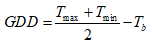
Where,

Tmax = Daily maximum temperature (°C) during a day

Tmin = Daily minimum temperature (°C) during a day

Tb = Minimum base temperature. For mungbean it was taken as 10°C [8]


Accumulated growing degree day (AGDD):

       1.5. Collection of Dry Matter Partitioning Data

For dry matter partitioning data, plants from 50cm × 30cm area were sampled from each plot of each replication at each developmental stage by destructive sampling starting from the first trifoliate stage. Then sampling was done regularly at the third trifoliate stage, first and 50% flowering stage, first pod initiation stage, and maturity stage. The destructive sample collection area was marked with red tape. Yield and yield contributing characters were not measured from these marked areas. The leaves, stems, and reproductive parts (fruit, flower) were separated and dried in an oven at 75 °C temperature for 48 hours. The summation of the dry weight of stem leaves and the reproductive part gave total dry matter accumulation which was then calculated in terms of g/plant [9].

1.6. Statistical Analysis

The collected data were analyzed by the statistical software MSTAT-C and the least significant differences were calculated at a 5% level of significance [10].

Results & Discussion

        Phenology of Mungbean Affected by Different Sowing Dates

Days required for different development stages of mungbean are represented in Table 1. Significant differences were observed among different sowing dates induced by temperature variation, photoperiod, and solar radiation. Mungbean sown on 15 January required the maximum days (7 days) to emerge. This may be due to the prevailing low air temperature and humidity during the initiation of the experiment. Days required for emergence gradually decreases for other sowing dates. Delayed sowing hastens the emergence of mungbean. Mungbean crop sown on 15 January required the maximum days to reach two-leaf stages (13 days) and trifoliate stage (36 days). Mungbean sown on 15 January required the maximum days (50 days) to reach the first flowering stage whereas the crop sown on 15 February required the lowest (42 days). A similar trend can be observed from days required to 50% flowering. Earlier 50% flowering with delayed sowings has been observed in mungbean [11]. Early sown mungbean demonstrated the maximum days to reach maturity (87 days) whereas the 15 February sown crop exhibited the least (71 days). For maturity, it was observed that delayed sowing shorten the life cycle of mungbean.


Table 1: Days required for different development events of mungbean at different sowing dates


Means bearing same letter (s) do not differ significantly at 1% level of probability by DMRT.

        Accumulated Growing Degree Days

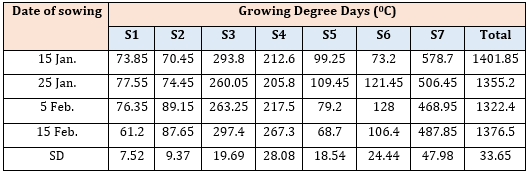
Accumulated growing degree days (GDD) were calculated for different development events of mungbean at different sowing dates represented in (Table 2). The crop had faced an increased pattern of accumulated growing degree days at the vegetative stage that reached the maximum at the two-leaf stage to the trifoliate stage. At the two-leaf stage to the trifoliate stage, the crop sown on 15 February faced the highest accumulated GDD (297.4 °C) might be a cause of high temperature prevails at the early stage of delayed sowing. At the trifoliate stage to the first flowering stage, accumulated GDD was the maximum at 15 February sown crop (267.3 °C) and then 217.5 0C at 05 February sown crop. At first flowering to 50% flowering stage and 50% flowering to the first pod initiation stage, GDD accumulation was declined due to a short interval existed between the stages. At first pod initiation to maturity stage, the maximum GDD was accumulated by the crop sown on 15th January (578.7 °C) and the minimum by 05th February sown crop (469 0C). The maximum total GDD was accumulated by the mungbean sown on 15 January (1402 °C). Crop sown on 15th February accumulated 1376.5 °C of total GDD and the minimum total requirement was observed at 05th February sown crop (1322.4 °C) (Table 2). Early sown mungbean crop consumed more number of GDD to attain physiological maturity compared to late sown mungbean [12].


Table 2: Growing degree days (GDD) accumulated for different development events of mungbean at different sowing dates

Note: S1: Sowing-Emergence, S2: Emergence- first trifoliate stage, S3: first trifoliate stage-third trifoliate stage, S4: third trifoliate stage- 1st flowering stage, S5: 1st flowering stage- 50% flowering stage, S6: 50% flowering stage-1st pod initiation stage, S7: 1st pod initiation- Maturity stage
        Dry Matter Partitioning

The result of the dry matter production of mungbean influenced by sowing date is presented in Figure 1. From the Figure 1, it can be observed that, sowing at 05 February and sowing at 15 February dominated in dry matter production in every developmental stage in different plant organs. At first trifoliate leaf development stage, the crop sown at 15 February had produced the maximum source dry matter into leaves (0.79g/plant). This may be due to high temperature and humidity enhances rapid dry matter accumulation, the higher rate of photosynthesis, and hence growth. Among other sowing dates, the crop sown on 05 February had produced 0.77g/plant dry matter. The crop sown on 25 January had produced 0.53 g/plant dry matter at the first trifoliate leaf development stage and 15 January sowing had produced the least (0.43 g/plant) (Figure 1).
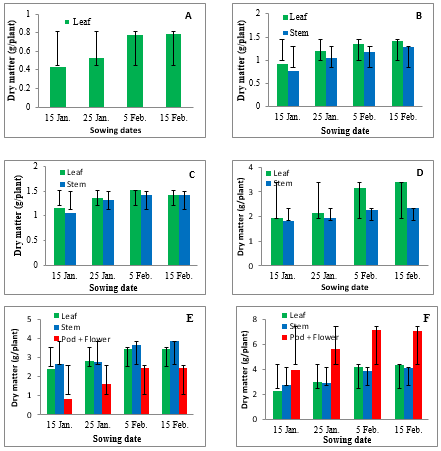
At the third trifoliate leaf development stage, mungbean sown on 15 February had produced the maximum dry matter into leaves (1.42 g/plant) and stems (1.29 g/plant). The crop was sown on 05 February also had produced statistically identical dry matter production into leaves. The least dry matter had been produced by the crop sown on 15 January into leaves (0.9 g/plant) and stem (0.78 g/plant) (Figure 1B). At first and 50% flowering stage, mungbean sowed on 05 February and 15 February significantly produced the statistically identical maximum dry matter into source whereas sowing on 15 January had produced the least (Figure 1C, 1D). At the first pod initiation stage, likewise, other developmental stages the maximum dry matter production can be observed from 05 February and 15 February sown crop into leaves (3.4 g/plant) and stems (3.8 g/plant). Consequently, they also translocate the maximum dry matter into the sink (pod + flower) (About 2.45 g/plant). Mungbean sown on 15 January had trans-located the least amount of dry matter into pod + flower (0.82 g/plant) (Figure 1E). This may be due to lower dry matter accumulation into the source at the early sown crop. At the maturity stage, the maximum dry matter production can be observed from 05 February and 15 February sown mungbean crop. Sowing on 05 February had produced the maximum dry matter in the reproductive part (7.13 g/plant) which was statistically similar to 15 February sown crop (7.12 g/plant). The minimum dry matter in the reproductive part was accumulated by sowing on 15 January (3.93 g/plant) (Figure 1F).

Yield and yield contributing attributes

Significant differences can be observed from yield and yield contributing characters of mungbean influenced by different sowing dates except for plant population/m2, pod length, and the number of pods/plant characters. The number of seed/pods differs significantly among the sowing dates. The maximum number of seeds/pods can be observed from the crop sown on 05 February (12.67) which were statistically identical to 15 February sown crop (12.10) [Table 2]. The minimum number of seeds/pods can be observed from sowing on 15 January (8.53). Thousand seed weight differs significantly among different sowing dates. The heaviest thousand-grain weight was exhibited by the crop sown on 05 February (46.4 gm) which is statistically identical to 15 February sown mungbean (45.6 gm). Consequently, the lightest thousand-grain weight can be observed from 15 January sown mungbean (34.4 gm). This may be due to lower dry matter accumulation in the reproductive part as a consequence of early sowing and higher GDD accumulation (Table 3). The highest seed yield can be observed from the crop sown on 05 February (1.73 t/ha) which is statistically identical to the crop sown on 15 February (1.70 t/ha). Mungbean sown on 15 January exhibited the lowest seed yield (0.93 t/ha) (Table 3).

Table 3: Yield and yield contributing characters of mungbean at different sowing dates.

Conclusion and Recommendations

From the above study following conclusions and recommendations can be drawn out-

i)                    Early sown mungbean demonstrated the maximum days to reach maturity (87 days) whereas delayed sown crop exhibited the least (71 days). Delayed sowing shortens the life cycle of mungbean.

ii)             The maximum dry matter production in the reproductive part (7.23 g/plant and 7.12 g/plant) can be observed from late sown (05 February and 15 February, respectively) mungbean. The minimum dry matter in the reproductive part was accumulated by early sown crop (3.93 g/plant).

The highest seed yield can be observed from the crop sown on 05 February (1.73 t/ha) which is statistically identical to the crop sown on 15 February (1.70 t/ha). Early sown mungbean exhibited the lowest seed yield (0.93 t/ha) (Figure 2).

Data collected were tabulated and SPSS version 22.0 was used to analyze them statistically using the frequency test.


Tuesday, 20 October 2020

Journals on Orthopedics| JBGSR


Abstract

      Background: An open-label clinical study was conducted to evaluate the efficacy and tolerability of regenerative injecting therapy. The purpose of the study: to assess the effectiveness of regenerative injecting therapy, as well as to analyze the degree of effectiveness of this method in patients with vertebrogenic pain syndromes.
Materials and Methods: The study involved 30 patients of both sexes aged 20 to 60 years with vertebrogenic pain syndromes: chronic lumbalgia, vertebrogenic syndrome due to spondyloarthrosis, radiculopathy. General clinical (clinical and neurological, using scales for pain assessment), instrumental (X-ray, magnetic resonance imaging, ultrasound), laboratory methods were used.
Results: The results of the study of regenerative injecting therapy showed a statistical improvement in the patients’ condition. According to the long-term results, conservative treatment (regenerative injecting therapy) has been shown to improve physical well-being, increase the ability to work, general perception of the quality of life of patients, and also had good tolerability.


Keywords: Lumbalgia; Protrusion; Spondyloarthrosis; Regenerative injecting therapy

Introduction

The problem of pain in the lower back is the most common reason for patients to see a neurologist and orthopedist-traumatologist. In Ukraine, the number of patients with this pathology is constantly growing. Thus, in 2015, 3,249,396 cases of musculoskeletal diseases were registered in the adult population, which is 36,916 (1.15%) more than in 2014. The incidence increased by 1.67% and is 1102.44 cases per 10,000 adult population [1-3]. In the world, this pathology predominates among the diseases that cause temporary disability, and in the EU is the second most frequent cause visiting the doctor [4,5]. Lower back pain is the most common cause of disability. At the same time, between the ages of 30 and 45, only 40% of patients seek medical help.


The importance and urgency of this problem is evidenced by the significant proportion of adverse effects of this symptom complex, high prevalence and unsatisfactory results in some patients, despite the existence of modern effective therapy. Polymorphism of symptoms of degenerative diseases of the spine is due, firstly, the pathology of a large number of structural and functional elements of the vertebromotor segment [6,7]; secondly, the multiplicity of conflict options of the elements of the vertebromotor segment and the elements of the spinal cord, blood vessels [8-10]; third, somatovegeta tive connections of spinal segments and elements of the spinal cord with other organs and systems of the body. The causes of radiculopathy are edema and ischemic changes in the surrounding tissues [5].


Today, the possibility of reducing the duration of rehabilitation due to early activation of the patient is increasing. However, in recent decades, the direction of minimally invasive or interventional methods of treatment, which are currently allocated in a separate direction. A distinctive feature of usage of platelet-rich plasma (PRP-therapy) is its physiology, absence of allergic manifestations, the ability to influence various links in the pathogenesis of the disease, and the organic combination with other therapeutic factors [11]. Nowadays, PRP therapy is one of the successful areas of tissue engineering and cell therapy in medicine. When tissue is damaged, platelets play an important role in tissue healing and regeneration by releasing growth factors that have a positive effect on bone and cartilage regeneration. One of the main mechanisms of regeneration is to increase blood supply to tissues by stimulating angiogenesis [12]. 

Objective

 To evaluate the results of treatment of pain caused by protrusions and spondyloarthritis, using the method of application of platelet-enriched plasma.

Materials and Methods

The clinical study was conducted with 30 patients of both sexes aged 20 to 60 years with vertebrogenic pain syndrome, who were on outpatient treatment in the outpatient department of the Institute of Traumatology and Orthopedics [13]. Among those explored were 18 (60%) women and 12 men (40%). The mean age of patients was 43.8 ± 4.2 years. All patients received comprehensive conservative treatment before going to the clinic: nonsteroidal anti-inflammatory drugs (NSAIDs) - 30 (100%) patients, gabapentin - 18 (52.6%), physiotherapy - 11 (40.6%), therapeutic gymnastics - 15 50%), paravertebral injection of corticosteroids - 8 (22.2%).


All patients got injections of platelet-enriched plasma in facet joints at the level of L1-L2, L2-L3, L4-L5, L5-S1 of the spine under the control of ultrasound (US).


During treatment, all patients were examined by general clinical methods:
1.       Objective examination of the patient (measurement of heart rate, blood pressure, examination of the skin and mucous membranes);
2.       Registration of subjective complaints of the patient;
3.       Neurological examination.


Instrumental examination methods were used: radiography, magnetic resonance imaging (MRI), ultrasound and electromyography of the lower extremities. Laboratory examination was also performed: general blood test (erythrocytes, hemoglobin, color index, platelets, leukocytes, erythrocyte sedimentation rate). The main complaint of patients was low back pain. MRI results in all patients confirmed intervertebral disc protrusion and spondyloarthritis of the facet joints of the lumbar spine. Quantitative and qualitative assessment of the pain syndrome was performed using a visual analog scale (VAS) of pain. Patients were assessed before the procedure and on days 7, 13, 21, and 27 of the study. Criteria for inclusion in the study: patients with pain on the background of protrusions, deforming osteoarthritis of facet joints with neurological symptoms, the ineffectiveness of conservative treatment. Systematic usage of NSAIDs for reducing pain [14,15].


Patients were fasted 40 ml of blood from the ulnar vein, after which the blood was evenly distributed in 2 sterile vacutainers with sodium citrate solution and centrifuged for 8 min (speed - 1800 rpm) with an acceleration of 460 on the device CENTRSFUGE CM-6M. After centrifugation of whole blood and its subsequent layer stratification in sterile conditions with a sterile syringe, a layer of plasma rich in growth factors was taken, determining the number of erythrocytes, leukocytes and whole blood platelets and in optimal plasma after centrifugation. On average, after centrifugation, a growth factor-rich plasma of 5.0 ml was obtained and under control of ultrasound diagnostics (Philips HD-11 XE №USD0874946, 2009), using a multifrequency cone sensor the active substance was injected paravertebrally into the facet joints up to four times every 7 days. The study was performed on the affected areas, compared with healthy ones.


Statistical analysis of the obtained results: analysis of categorized data was performed using the following criteria: Q-criterion of Cochren (to establish the effectiveness of treatment in the dynamics); separate pairwise comparisons in the middle of the groups were performed using the McNemar test, the analysis of scores was performed using statistical Friedman criteria (single nonparametric analysis of variance).

Results and Discussion

       At the initial examination of vertebral neurological signs most often encountered changes were in the lumbar spine due to deforming osteoarthritis of the joints at the level of L2-L3, L3-L4, L4-L5, L5-S1 in 30 patients (100%). Of these, 7 patients (23.3%), in addition to spondyloarthritis of their joints, had manifestations of radiculopathy L4, L5, S1 level on the background of protrusions of the intervertebral discs, and 5 patients (16.7%) - with pain caused by spondyloarthritis, with severe reflex-muscular-tonic manifestations (piriformis syndrome). The acute course of the disease was noted in 6 patients (20%), chronic - in 24 (80%). All patients radiologically revealed degenerative-dystrophic changes of the lumbar spine, MRI - spondylosis, spondyloarthritis, and protrusion of intervertebral discs. Irritation of the roots at the level of L3, L4, S1 was confirmed by electroneuromyography of the lower extremities. On objective neurological examination, all patients were diagnosed with pain in the lumbar spine with irradiation to the lower extremities, paresthesias in the relevant dermatomes, reduced knee, Achilles and plantar reflexes (Figure 1).

Figure 1: Dynamics of VAS Indicators at the Stages of Observation.


Vertebrogenic syndrome on the background of deforming arthrosis of the joints of the spine in 30 patients (100%) was manifested by severe localized pain, accompanied by immobility and stiffness of the affected spine, increased fatigue and greatly increased with a change in a static position (especially in the morning or after significantly decreased or disappeared after movements. Radical syndrome (radiculopathy) was observed in 7 patients (23.3%) and was characterized by radiating pain in the corresponding dermatome, a feeling of paresthesia, decreased reflexes (knee, plantar, Achilles) in 2 patients, muscle malnutrition. Piriformis syndrome was manifested by pain in the lumbosacral spine - in 5 patients (16.7%), on the outer thighs, anterior tibia, tension of the femoral adductors and pain on palpation and stretching in them (Table 1).


Table 1: The analysis of subjective and objective neurological symptoms allowed us to identify the leading clinical syndromes.

Complete reduction of pain after treatment was observed in 18 patients (60%), and in most (12 patients, 40%) it was registered by the 14th day of treatment, in 4 patients (16.4%) - by the 21st day of therapy and only in 2 patients (6.6%) - up to the 27th day of treatment. Of the 8 patients (26.7%) who received a 27-day course of treatment, only 2 patients (6.6%) showed complete reduction of pain, and 2 patients (6.6%) had minor pain, which was intermittent and appeared during the day. These were patients with a long history of pain (more than six months), mostly women, and with more distinct changes in spinal radiography and MRI.


Before treatment, 19 patients (63.3%) rated the severity of pain for VAS as 6-8 cm, 9 patients (30%) - 8-10 cm and only 2 (6.7%) - 4-5 cm. After the treatment course, the absence of pain in the spine was noted by 17 patients, it was assessed by YOU from 2 to 3 cm - 9 patients, from 3 to 4 cm - 4 patients. Thus, a complete reduction of the pain syndrome for VAS was observed in 56.7% of patients, a significant reduction - in 30%, a slight - in 13.3% of patients. According to the scale of general clinical impression, the severity of the disease was classified as "moderate changes" in 21 patients - reduction of vertebrogenic pain, restoration of knee, plantar, Achilles reflexes, and preservation of sensitivity in the relevant dermatomes. Significant changes - in 7 patients, as mild manifestations - in 2 patients in the form of malnutrition of the muscles of the thigh, leg, hypostasis in the relevant dermatomes. During the study, under the influence of regenerative injection therapy, patients significantly reduced complaints, there was a positive quantitative dynamic of subjective and objective neurological symptoms. Significant improvement - in 60% of patients, moderate improvement - in 33.3% of patients. Survey and neurological examination of patients during treatment did not reveal any additional complaints, unexpected side effects, complications or allergic reactions.

Conclusion

       1.       The method of regenerative injection technology is effective in the treatment of pain in deforming arthrosis of the lumbar spine and protrusions of the intervertebral discs. However, it is not universal and cannot slow the progression of the underlying disease, so it is recommended to be used with other treatments.
2.      Two or three injections of the drug in the early treatment of deforming arthrosis of the lumbar spine inhibits the development of degenerative-dystrophic process, which, in turn, has a positive effect on the dynamics of pain.

The procedure of regenerative injections requires further study in a significant number of patients with long-term follow-up.


Monday, 12 October 2020

Secondary Hemophagocytic Syndrome in an 82-Year-Old Covid-19 Patient by Francesk Mulita in OAJBGSR (Open Access Journal of Biogeneric Science and Research)

Secondary Hemophagocytic Syndrome in an 82-Year-Old Covid-19 Patient by Francesk Mulita  in OAJBGSR (Open Access Journal of Biogeneric Science and Research)


OAJBGSR

Abstract

Background: Postoperative fever is defined as a temperature greater than 38oC on two consecutive postoperative days or greater than 39oC on any postoperative day. Case presentation: We herein report a case of an 82-year-old male who presented to our hospital complaining of abdominal pain and fever. Chest radiography of this patient showed right pleural thickening, but his first Covid-19 test was negative. After 7 days of hospitalization, his general situation became worse as well as he became hypoxic to 80% oxygen saturation and remained spiking fevers up to 39oC. He was positive to the second Covid-19 test. The patient was intubated. According to blood results tests our patient had secondary hemophagocytic syndrome, which is a life-threatening syndrome of excessive immune activation that can also be induced by SARS-CoV-2 infection. Unfortunately, he died and there was no further management. Conclusions: COVID-19 was declared as a global pandemic. It is very important nowadays this pathology to be excluded from all patient presenting to emergency departments complaining of fever.


Keywords: COVID-19; Secondary hemophagocytic syndrome; Postoperative fever

Introduction

Postoperative fever is defined as a temperature greater than 38 °C on two consecutive postoperative days or greater than 39 °C on any postoperative day [1]. We herein report a case of an 82-year-old male who presented to our Emergency Department complaining of abdominal pain and fever.

Case Report

An 82-year-old male with free medical history presented to our hospital with fever and abdominal pain for 3 days which was not associated with heartburn, vomiting, melena or haematemesis. He had undergone open cholecystectomy one year ago and an open postoperative hernia repair in the right Kocher’s incision was performed 25 days ago. Patient’s temperature was 38.4 °C, heart rate was 107 beats per minute, blood pressure was 161/113 and respiratory rate was 19 breaths per minute. On examination, it was revealed moderate tenderness in the region of upper abdomen with no rebound tenderness. Bowel sounds were audible, and rectal examination was normal. The initial haemoglobin was 11.2 g/dL, white blood cells were 5.11 K/μl, platelets were 210.000 K/μl and C-reactive protein level was 10 mg/dL. Liver and renal function test and serum amylase were normal. Chest radiography showed right pleural thickening (Figure 1). A further computed tomography (CT) scan of the abdomen and chest demonstrated pleural thickening of the inferior half of the right middle lobe (Figure 2) as well as low volume of free intra-peritoneal fluid. Because of the history of recent surgery the patient was initially hospitalized in the surgical clinic, as his first Covid-19 test was negative. The patient remained in the surgical clinic for 4 days without having any surgical problem and received intravenous antibiotics empirically. During his hospitalization he had no abdominal pain and was started on oral diet. However, his chest radiography showed no improvement (Figure 3) and he was referred to internal medicine department for further management.

Figure 1: Chest radiography showing right pleural thickening.

Figure 2: Chest CT scan demonstrating pleural thickening of the inferior half of the right middle fissure with adjacent subsegmental atelectasis of the lateral segment of the right middle lobe.

Figure 3: Chest radiography showing right pleural thickening after 4 days of hospitalization.


A second Covid-19 test was sent while the patient was hospitalized in internal medicine clinic and it was positive. After 4 days of hospitalization there, his general situation became worse as well as he became hypoxic to 80% oxygen saturation while on nasal cannula and remained spiking fevers up to 39oC. He was intubated and transferred to the intensive care unit (ICU) for further management and was switched to ceftriaxone 1 g intravenously daily and azithromycin 500 mg via orogastric tube daily and was started on hydroxychloroquine 400 mg loading dose followed by 200 mg twice daily for a 7-day course. Seven days after intubation his haemoglobin was 10.5 g/dL, white blood cells were 2.73 K/μl, platelets were 65.000 K/μl and C-reactive protein level was 3.83 mg/dL. Patient’s ferritin was 18.111 ng/ml and his transaminases, LDH and triglycerides were elevated. According to these findings there was a suspicion of hemophagocytic syndrome in our patient. Unfortunately, he died the same day and no further management was made.


Discussion

Coronavirus disease 2019 (COVID-19) is a disease caused by a novel coronavirus, called severe acute respiratory syndrome coronavirus 2 (SARS-CoV-2) [2]. The incubation period for COVID-19 is thought to be approximately 14 days following exposure, with most cases occurring four to five days after exposure [3]. Clinical manifestations of Covid-19 disease show a wide spectrum of severity. Generally, the fatality rate is thought to be approximately 2.3 %. The most common symptoms reported in coronavirus infection are the following: fever, cough, dyspnea, sore throat, rhinitis, fatigue and diarrhea. Most of the deaths reported are due to acute respiratory failure, ARDS and shock and multiorgan failure [4-5].


Diagnosis of the SARS-CoV-2 infection is based on laboratory findings, and specific tests. Most common laboratory findings include: Leukopenia, leukocytosis, lymphopenia and high levels of lactate dehydrogenase and ferritin [6]. Chest CT scanning in patients suffered from SARS-CoV-2 infection usually show ground-glass opacities and infiltrating consolidation [7-8].


The appropriate management and treatment of SARS-CoV-2 infection is under investigation. During the outbreak of the COVID-19 hydroxychloroquine, chloroquine, or lopinavir/ritonavir were more commonly used, but eventually these drugs showed little or no reduction in mortality rates compared with standard of care. No vaccine is currently available for SARS-CoV-2 [9]. Recently, antibodies tests are available detecting specific IgM and IgG antibodies against SARS-CoV-2 [10]. Hemophagocytic lymphohistiocytosis (HLH) is an aggressive and life-threatening syndrome of excessive immune activation. It most commonly appears in infancy, although it has been seen in all age groups [11]. It is categorized into two major types: HLH syndrome – A condition of pathologic immune activation that is often associated with genetic defects of lymphocyte cytotoxicity and HLH disease – A condition associated with infections, malignancy and rheumatologic conditions and is mostly seen in adults. Viral pathogens that are associated with HLH are Epstein-Barr virus (EBV), cytomegalovirus (CMV), parvovirus, herpes simplex virus, varicella-zoster virus, measles virus, human herpes virus 8 and H1N1 influenza virus. It is worth mentioning that HLH is probably associated also with SARS-CoV-2 [12-15].


Clinical manifestations of HLH include: Fever, cytopenia (especially anemia and thrombocytopenia), splenomegaly, dyspnea, ARDS syndrome, renal failure, severe hypotension and skin manifestations such as generalized rashes, erythroderma, edema, petechiae, and purpura [16]. Diagnosis is based on laboratory findings and bone marrow biopsy. Characteristic laboratory findings include: cytopenias in the peripheral blood, hypertriglyceridemia, hypofibrinogenemia, high ferritin levels (>500 mcg/L) and elevated levels of LDH, hemophagocytosis, low/absent NK cell activity and soluble CD25 elevation. Bone marrow evaluation is recommended for the diagnosis of HLH. Infiltration of the bone marrow by activated macrophages is commonly seen in patients with HLH and supports the diagnosis [17]. Puja Mehta and colleagues suggest using the HScore to detect hyperinflammatory states in patients with coronavirus disease 2019 (COVID-19). This score validated for the diagnosis of secondary haemophagocytic lymphohistiocytosis (sHLH), a condition that shares a similar cytokine profile to severe COVID-19 [18].

Conclusion

COVID-19 was declared as a global pandemic. It is very important nowadays this pathology to be excluded from all patient presenting to emergency departments complaining of fever. Secondary hemophagocytic syndrome is life-threatening syndrome of excessive immune activation that can also be induced by SARS-CoV-2 infection.

Declaration of Conflicting Interests

The authors declared no potential conflicts of interest with respect to the research, authorship, and/or publication of this article. 

Funding

The authors received no financial support for the research, authorship, and/or publication of this article. 

Informed Consent

Written informed consent was obtained from the patient for their anonymized information to be published in this article and approved by local ethics committee.

Authorship

FM, NO, LT and EL: contributed to the clinical data collection and prepared the case report. FM and IM: contributed to the design of the case report presentation and performed the final revision of the manuscript.

To know more about our Journal click on https://biogenericpublishers.com/
Open Access Journal of Biogeneric Science and Research (OAJBGSR)

For article: https://biogenericpublishers.com/pdf/JBGSR.MS.ID.00080.pdf

https://biogenericpublishers.com/jbgsr.ms.id.00080.text/

Tuesday, 6 October 2020

Role of Potassium in Maize Production: A Review by "Muhammad Adnan" in Open Access Journal of Biogeneric Science and Research

Role of Potassium in Maize Production: A Review by "Muhammad Adnan" in Open Access Journal of Biogeneric Science and Research


Abstract
In all over the world Maize (Zea mays L.) crop is used both for food and feed purpose. Various factors which contributes toward slow production of corn in Pakistan are nutritional in-balance, insufficient use of fertilizer, low soil organic matter contents, inadequate plant density, weeds problem, scarce water supply, selection of unsuitable varieties and insect pest attack. Potassium is considered as most ambient macronutrients required for proper growth, development and sustainable crop yield. Keeping in mind the importance and role of potassium (K) in improving both chemical and physical properties of soil the present review focuses on the effect of potassium on growth yield and quality of maize.

Introduction
In all over the world Maize (Zea mays L.) crop is used both for food and feed purpose [1]. In Pakistan, maize ranks 3rd among the cereal crops after rice and wheat [2]. Maize is cultivated in subtropical, tropical, and temperate provinces of all world therefore, this crop has worldwide adaptability [20]. Maize crop matures more quickly because of its foliage distribution and size [3]. Worldwide area under the cultivation of maize crop is about 159 million hand total yield is 796.48 million [4]. Maize crop is used as a multipurpose which provides fodder for animals, fuel and food for humans being [5]. It is used in cake formation, porridge and bread making in all over the world especially in Africa, America and Asia [2]. Various factors which contributes toward slow production of corn in Pakistan are nutritional in-balance, insufficient use of fertilizer, low soil organic matter contents, inadequate plant density, weeds problem, scarce water supply, selection of unsuitable varieties and insect pest attack [6]. Balanced nutrition is an imperative feature which shows a main function in achieving quality production of maize. Presence of nutrients like magnesium, phosphorus, nitrogen and potassium in well-adjusted forms is necessary for plant growth, development and final yield [7]. Potassium is considered as most ambient macronutrients required for proper growth, development and sustainable crop yield [8]. Maize consumed 5.2 kg P2O5 ha-1 per day during peak flowering period [9]. After sowing during 38 to 52 days, the maize plants require the total potassium up to 38% for whole growing season [10]. It improves the overall yield of maize [30]. It also helps plant to regulate the movement of stomata [11]. Potassium plays major role in stimulation of enzymes, photosynthesis, regulation of osmotic pressure, movement of the stomata’s, protein synthesis, phloem transport, transfer of the energy, cation-anion balance in soil and improves resistance against stress [12]. In depth of soil, potassium application in association with the other inorganic nutrients, such as phosphorus and nitrogen produce the deeper roots of plants [13]. Keeping in mind the importance and role of potassium (K) in improving both chemical and physical properties of soil the present review focuses on the effect of potassium on growth yield and quality of maize.

Effect of Potassium on growth and Yield of Maize
[14] Observed the influence of different levels of potassium and phosphorus fertilizers on the yield and yield attributes of maize (Zea mays L.) varieties. The results indicated that higher rates of both potassium and phosphorus fertilizers have significantly enhanced the weight per ear, No of grains per ear and the 1000-grains weight. Sole effect of potassium was found non-significant for grain yield but in interaction with phosphorus levels and maize varieties potassium produced the better yield. But alone the phosphorus levels and it interaction with potassium levels and maize hybrids showed significant effect on grain yield. Moreover, 90 kg ha-1 phosphorus and 60 kg ha-1 potassium gave the maximum grains yield [15] studied the effect of potassium maize and reported that Potassium @ 200 kg ha-1 produced maximum grains yield. [16] Studied the response of maize to potassium and reported that increase in potassium levels the maize showed an increase in yield constituents. The maize exhibited maximum yield when potassium was used @ 125 kg ha-1 as compared to the control treatment. They also concluded that potassium @ 125 kg ha-1 produced the economical yield of maize hybrids. [17] Studied the effect of potassium application on maize (Pioneer-3062, Pioneer-3012, Pioneer–30D55). Maize hybrid (Pioneer-30D55) gave more no. of grains row-1, no. of grains cob-1 and higher grains weight cob-1 when potassium was applied @ 200 kg ha-1. [18] Studied the effect of potassium on maize (Pioneer 3062) yield in Pakistan. Potassium was applied @ 0, 60 and 120 kg ha-1 in K2O. The results showed that maximum grains yield of maize (8014 kg ha-1) was obtained in the plot where 120 kg ha-1 of potassium was used in three splits and minimum grains yield was recorded in control plots. [19] reported that higher potassium application (60.0 kg ha-1) was expressively better to lower rate of potassium application as (30.0 kg ha-1). The production of biomass and growth of maize i.e. diameter of shoot, length of shoot, fresh biomass of shoot, dry biomass of shoot, no. of leaves of plant per hectare and leaf area improved by the potassium application @ 60.0 kg ha-1.

[20] Studied the response of maize hybrid (32F10) to potassium fertilizer. They reported that application of potash fertilizer significantly improved the several characters of maize, viz. production of fresh biological yield (12 to 60%), grain yield (21 to 84%), cob yield (16to 76%), 1000-grains weight (2 to 30%) and accumulation of potassium (150.0 to 366.0%). [21] evaluated the influence of several potassium levels i.e. (0.0, 125.0, 150.0 and 175.0 kg ha-1) on the growth and production of maize hybrid (Hycron 11 Plus). The results showed that use of potassium significantly improved both the quality and yield parameters of the maize cultivar. It was observed that potassium @ 175.0 kg ha-1 gave the greater plant height (273.72 cm), cob size (22.30cm), no. of rows cob-1 (17.84), no. of grains cob-1 (541.76 No.) and 1000-grians weight (457.12 g). [22] Concluded that that increasing potassium fertilizer levels significantly improved the maize yields. [23] Evaluated the role of potassium nutrition under water deficit (50% field capacity) for improving the productivity of maize hybrids (P-32B33) and (NK-8441) at stem enlargement (BBCH-36) and at the tasseling (BBCH-59) stage by suppressing the irrigations. They reported that water deficit at both (BBCH-36 and BBCH-59) stages reduced the productivity of both maize hybrids. However, potassium application enhanced the root system, grain yield and net income of both tested hybrids under stress and optimal water conditions.

 Therefore, it was suggested that potassium nutrition not only helped in reducing the damaging effects of drought due to maximum development of roots system but also improved the yield and net income. [24] studied the effect of several potassium levels i.e. (0, 60, 90 and 120 kg ha-1) on four spring planted maize hybrids i.e. (CS200, 30K08, 3025 and 2031). Potassium @ 90 kg ha-1 enhanced the maize yields and yields related constituents but increasing potassium level above 90 kg ha-1 showed no significant effect. Maize hybrid CS200 produced more grain and biological yield than that of other hybrids. From the results it was concluded that the hybrid-CS200 at potassium level (90.0 kg ha-1) should be used for obtaining the maximum grains yield of maize.

[25] Reported that usage of potassium enhanced the yields and growth of plants under drought stress condition. Therefore, it was suggested that potassium should be applied as an approach to minimize the water scarcity in maize crop. [26] studied the different characters of maize cultivar (Cv. Azam) at the different potassium levels (30.0, 60.0 and 90.0 kg ha-1) and reported that plots which received the potassium @ 90.0kg ha-1 produced the greater no. of leaf plant-1, maximum average leaves area, accumulated maximum dry matter into several parts of plants i.e. (stems, ears and leaves), gave higher biological yield and H. I of maize as compared to control. [27] Studied the efficiency of foliar applied potassium (K) against soil applied on hybrid maize.

Treatments were comprised of (control, soil applied potassium @75.0 kg ha-1 of K2O, foliar spray of 1% K2O, foliar spray of 2% K2O, foliar spray of 3% K2O, fertigation of Potassium @7 5.0 kg ha-1 in K2O form and split application of Potassium @75.0 kg ha-1 in K2O form in the soil. Foliar application of potash fertilizer increased the yield. And yield attributes along with the grains quality characteristics of maize hybrid. Foliar treatment of 3% K2O gave the maximum biomass production (15.0 tonnes ha-1) and grains yield (8.08 tones ha-1) of hybrid maize followed by foliar spray of 2% K2O. It was also determined that foliar application of potassium gave the greater net benefit and benefit cost ratio. Therefore, it was suggested that potassium foliar spray at 3% concentration more efficient for increasing the growth, development and yields of maize as equated to fertigation and soil applied of potassium fertilizer.

Effect of Potassium on Quality of Maize
[28] Studied the effect of potassium on stalk and quality parameters of the maize. Potassium @ 200 kg ha-1 showed maximum P (0.082%), N (0.751%), K (1.87%) concentration in stalk, and beyond this limit these parameters tended to decline when phosphorus @ 250 kg ha-1 was used. But at the higher potassium dose (250 kg ha-1) increase protein (8.32%), crude starch (72.65%), and oil (4.53%) contents in grains. On the result basis it was concluded that maize performed best with potassium rate 200 kg ha-1 but the grain quality parameters were recorded best at potassium level 250 kg ha-1. [28] determined the influence of several potassium levels i.e. (1, 2, 4, 6 and 8 mM) and iron levels i.e. (30, 60, 90 and 120 micro M) on macro nutrients uptake of the maize in a hydroponic system. Increasing the potassium and iron levels showed an increase in the total iron and iron concentration uptake by the maize. But the highest potassium dose decreased the uptake of iron. It was examined that P, Mg and Ca concentration decreased in the leaves and roots of maize by increasing the potassium levels.

[29] studied the different potassium fertilizer levels i.e. (0.0, 150.0 and 300.0 kg ha-1) which affect water use efficiency and restricted irrigation methods: full irrigation, variable and fixed partial root zoon drying (PRD-V and PRD-F) on yield of corn. It was concluded that highest WUE and IWUE were observed in PRD-V where potassium was @ 300.0 kg ha-1 and minimum WUE was found in full irrigation where 0.0 kg ha-1 of potassium was applied. Conducted an experiment to evaluate the potassium use efficiency of maize and reported that except control all potassium levels produced statistically similar potassium use efficiency (KUE). [30] Conducted an experiment to study the impact of different levels of potassium on maize and reported that maximum crude protein (7.66 %) and crude oil (3.66%) were observed when potassium was applied @ 160 kg ha-1. [31] Reported that potassium has major effect on water potential of the leaves, turgidity potential, and comparative moisture content in plants, rate of transpiration and photosynthesis rate. Thus it was concluded that potassium could be helpful for the tolerance in plants against the water scarcity conditions as well to develop the good quality production of crops.

[32] Determined the response of growth and development of two maize hybrids [YH-1898 (drought sensitive) and 32-F-10 (drought tolerant)] to different potassium levels under drought conditions. Two levels of drought viz. 70% field capacity and 100% field capacity (no drought) with the application of different K doses i.e. (0.0, 50.0, 100.0, 150.0 and 200.0 mg/kg of soil) were used. They reported that potassium @ 100.0 mg/kg gave better performance of variety (32-F-10) for photosynthetic rate (18.72 μ mol/m2/s) and relative water contents (83.68%). Similarly, the variety YH-1898 at potassium dose (100.0 mg/kg) produced photosynthetic rate (10.42 μ mol/m2/s) and relative water contents (68.16%). From the results it was observed that application of potassium under the drought stress significantly enhanced all the studied characters of maize in comparison with control treatment. [33-35] investigated the effect of potassium fertilization on nutrient uptake, growth and physiology of maize crop. Potassium fertilizer was applied in five different doses 0.0, 70.0, 100.0, 130.0, and 160.0 kg ha-1. They observed that increasing potassium application rate the nutrient uptake, plant growth, and concentration in roots and shoots, respiration rate, net photosynthesis, stomatal conductance and sub stomatal CO2 concentration were considerably improved. Potassium also improved the water use efficiency (WUE) of maize and decreased the root: shoot dry weight ratio.

Conclusion
It is concluded from the above review that maize is an important crop. Potassium is considered as most ambient macronutrients required for proper growth, development and sustainable crop yield. Most of the scientists reported that application of 60 kg potassium per ha is the best dose to obtain higher yield of maize. However, it depends on cultivar and soil. 

To know more about this article click on 

Thursday, 10 September 2020

Phenology, Thermal Time Requirement, Growth and Yield of Winter Mungbean (Vigna Radiata) as Influenced by Sowing Dates in Ganges Tidal Floodplain (AEZ-13) in Bangladesh by Khairul Bashar HM in Open Access Journal of Biogeneric Science and Research

Phenology, Thermal Time Requirement, Growth and Yield of Winter Mungbean (Vigna Radiata) as Influenced by Sowing Dates in Ganges Tidal Floodplain (AEZ-13) in Bangladesh by Khairul Bashar HM in Open Access Journal of Biogeneric Science and Research


Abstract
A field study was carried out at the Regional Agricultural Research Station, Bangladesh Agricultural Research Institute, Rahmatpur, Barishal during the late Rabi season of 2018 in Ganges Tidal floodplain (AEZ 13). The experiment was carried out with four different sowing dates

(i)            Sowing at January 15

(ii)           Sowing at January 25

(iii)          Sowing at February 05

(iv)          Sowing at February 15 under randomized complete block design with three replications to study the phenology, thermal time requirement, growth and yield of mungbean.

BARI Mung-6 was used as the variety. The results revealed that mungbean sown on 15 January required the maximum days to reach maturity (87 days) whereas 15 February sown crop required the minimum days to reach maturity (71 days). The lowest accumulated GDD (Growing Degree Days) was observed at sowing on 05 February (1322.4 °C) followed by sowing on 25 January (1355.2 °C) whereas the highest accumulated GDD was observed at sowing at 15 January (1401.85 °C). The highest dry matter production at pod + flower part was sowing at 05 February (7.13g/plant) followed by sowing at 15 February (7.12g/plant) which were statistically identical, sowing at 05 February had produced the highest seed yield (1.73 tha-1) which was statistically identical to sowing at 15 February (1.70 tha-1).

Keywords: Sowing date; Phenology; GDD; Dry Matter Partitioning

Introduction
Mungbean (Vigna radiata) is an important component in the intensive crop production system for its short life cycle and is one of the leading pulse crops of Bangladesh. The agroecological condition of Bangladesh is favorable for growing this crop. It is a drought-tolerant crop and can be grown with a minimum supply of nutrients. Cultivation of mungbean can improve the physical, chemical, and biological properties of soil as well as are capable of fixing atmospheric nitrogen by the symbiotic process with the help of micro-symbiont (Rhizobium). Mungbean has good digestibility and flavor. Mungbean contains 51% carbohydrate, 26% protein, 10% moisture, 4% minerals and 3% vitamins [1]. In Ganges Tidal Floodplain of Barishal region, 184655 ha areas are under mungbean cultivation and area coverage is increasing every year. Among the mungbean varieties, the major cultivation area is covered by BARI Mung-6 (62%) e.g. 115241 ha.

Crop physiological processes dependent on integrated atmospheric parameters in which temperature is an important weather parameter that affects plant growth, development, and yield [2]. Several physiological and morphological changes occur that involve the development of root, shoot and leaves, flowering, and seed formation. Each physiological and morphological characteristic may affect yield in many ways, the net effect of which depends on other characteristics, on environmental conditions, and agronomic practices. Plant morphological characteristics and yield-forming components must be better understood if maximum yields are to be realized and exploited. Sowing time, a non- monetary input, is an important factor to influence yield [3]. Depending on sowing dates crop faces variable temperatures, rainfall, and relative humidity, etc. which affect crop phenology, growth, and yield. Temperature is a major environmental factor that determines the rate of plant development.


The phenological stages of mungbean are mainly related to temperature. Mungbean being a tropical and a sub-tropical crop requires warm temperature regimes (24 to 30°C with average temperature 28 °C) for its growth but can tolerate high temperatures up to 40°C. This temperature requirement for different developmental stages is known as thermal time or growing degree days (GDD). Sowing dates induced temperature variability may change the duration of phenophasic development. The duration of each phenophase determines the accumulation and partitioning of dry matter in different organs as well as grain yield. To understand the physiological basis of yield difference of mungbean, it is essential to quantify the components of growth, and the variation, if any, may be utilized in crop improvement. Climate change has deleterious effects on crop production in terms of the period of maturity and yield. From the last few years, the change in climate has been observed by Swaminathan and Kesavan (2012), which may adversely affect the phenology and production of crops [4]. With a successful study on these thermal indices may provide the information on the crop phenology and approximate date of crop harvest. Therefore, the present investigation was undertaken to evaluate phenological changes, growth, and yield of mungbean under variable sowing dates.


Materials and Methods

1.1. Description of the Study Area
The experiment was conducted at the Regional Agricultural Research Station, Bangladesh Agricultural Research Institute, Rahmatpur, Barishal at Ganges Tidal Floodplain ecosystem (AEZ-13) during the late Rabi season of 2018. The research station is situated in the southern part of Bangladesh and located at 220 42″ N Latitude to 900 23″ E Longitude at an altitude of 4 m from mean sea level (MSL). The climate of the locality is sub-tropical. It has characterized by high temperature, high humidity, and heavy rainfall during the Kharif season (April to September) and low rainfall associated with moderately low temperatures during the rabi season (October to March). The water balance is negative from November to April.

The study area is a piece of well-drained medium high land with even topography. The area belongs to the agro-ecological zone of the Ganges Tidal Floodplain under AEZ- 13. The texture of the soil is clay loam in nature with low organic matter content (0.54-2.58) and a pH value of 6.8-7.2. These areas are slightly saline (0.65-1.90 dS/m), with some pockets being non-saline.

1.2.  Treatments and Experimental Design
The experiment was conducted in a single factor randomized complete block design with three replications. The treatments were as follows: Different sowing dates: (i) sowing at January 15 (ii) sowing at January 25 (iii) sowing at February 05 (iv) sowing on February 15. The unit plot size was 5m x 5m. Initially, the experimental area was divided into three blocks to represent three replications. Each replication contained four plots. Block to block and plot to plot distance was 1m and 0.5m respectively. BARI Mung-6 was selected as the variety. The experimental field was fertilized with 18-30-36-18 NPKS Kg/ha as a basal dose. Yield and different yield contributing characters were measured at harvest.


To know more about this article click on 
For Online Submissions Click on https://biogenericpublishers.com/submit-manuscript/